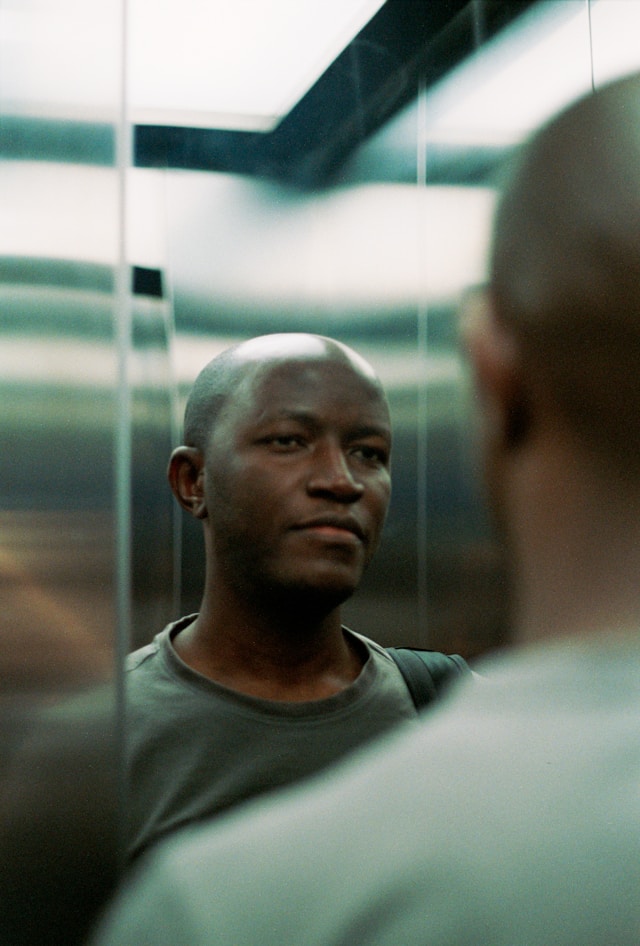
There is a mirror in your life that you have been avoiding.
Not the one in your bathroom — the one you pass every morning before the armor goes on, before the badge is clipped, before the title gets rehearsed in your posture. No. I am talking about the one that lives somewhere between your public performance and your private truth. The one that has no filters, no flattering light, no angle that makes you look better than you are. It just reflects.
Most leaders never look into it. Not really. They glance. They adjust. They move on. Because to truly look — to stand still long enough for that mirror to show you everything — requires a kind of courage that titles and credentials simply do not teach.
This is the Unfiltered Mirror.
And this is your invitation to stop running from it.
________________________________________
Why Some Leaders Avoid the Mirror
Let me be honest with you about something first, because that is what this conversation demands.
The leaders I work with are not weak. They are not careless. They are not unaware. They are some of the most disciplined, high-performing, mission-critical professionals on earth — people who manage secure credential supply chains, who hold the fate of organizations in their hands, who operate in environments where a single lapse can cascade into national security consequences.
And yet — almost universally — when I ask them to turn the lens inward, something shifts. Shoulders tighten. Language gets vague. The same person who can give you a precise threat matrix for a vendor access protocol will suddenly struggle to articulate what they actually believe about their own leadership.
Why?
Because the Unfiltered Mirror does not respond to authority. It does not care about your clearance level, your certification, or your performance review score. It does not show you the version of yourself you have spent years curating. It shows you the unedited truth — the gap between who you say you are and who you actually are when no one is watching, when the pressure is highest, when the room falls silent, and someone has to speak first.
Most of us have been trained — by organizations, by culture, by survival — to present rather than reflect. To perform leadership rather than practice it. To look out the window at everything happening around us and use that external noise as an excuse not to look in.
That is the Window vs. Mirror exercise. And it costs you more than you know.
________________________________________
The Window vs. Mirror: A Quick Foundation
Before we go deeper, let me ground this in a framework I come back to constantly in my work with leaders at every level.
The Window is where some leaders live. When things go well, some look out the window and credit the team, the timing, the resources, the environment. When things go wrong, they look out the same window — and find blame waiting on the other side. The window is always pointed outward. It is reactive, external, and ultimately disempowering because it puts the source of everything out there — beyond your control, beyond your responsibility, beyond your growth.
The Mirror is where accountable leaders choose to live. When things go well, they look in the mirror and ask: What did I contribute? What do I carry forward? When things go wrong, they look in the same mirror and ask: Where did I fall short? What was mine to own? The mirror is always pointed inward. It is proactive, internal, and radically empowering because it puts the source of transformation right where you can actually reach it — in you.
But here is what most people miss when I first introduce this concept.
There is a difference between looking in the mirror and looking in the Unfiltered Mirror.
The regular mirror — the one many leaders who have done personal development work will say they use — still has conditions on it. It is polished by ego. It is positioned at a flattering angle. It reflects the version of yourself you have decided to see. You look in it and say, I am accountable, I am aware, I am growing — but the reflection is still a managed one. Still curated.
The Unfiltered Mirror has none of that.
It shows you the moments you don’t photo-shop. The decisions you made in private that contradict the values you preach in public. The fears you have dressed up as principles. The relationships you have quietly abandoned because they asked too much of you. The legacy you claim to be building — and the gap between that claim and your daily calendar.
That mirror? Almost nobody voluntarily stands in front of it. But every leader who has ever broken through a ceiling — truly broken through, not just risen to the next level of performance anxiety — has had to face it.
________________________________________
What the Unfiltered Mirror Actually Shows You
I want to walk you through the four most common revelations I have witnessed when leaders finally commit to this kind of reflection. These are not comfortable. But they are necessary.
- The Distance Between Your Values and Your Actions
You say legacy matters. But how many mornings this week did you choose the urgent over the important? How many times did you let a compliant silence stand in when an honest word was needed? How many people in your circle are still being led by a version of you that you no longer believe in — and you have said nothing, done nothing, because disrupting that narrative feels too costly?
The Unfiltered Mirror does not let you say I value integrity while also showing you consistently compromising it for convenience. It holds both images up at once and asks you to explain the distance.
Most leaders’ greatest accountability gap is not between what they know and what they do. It is between what they say they believe and what their behavioral data actually proves. The mirror measures behavior. Not intention. Not aspiration. Behavior.
This is not a verdict. It is data. And data — if you are serious about leadership — is a gift.
- The Weight You Have Been Carrying in Silence
There is a particular kind of leader — and I see them constantly in the secure credential and federal security space — who has survived by not needing. Who learned early that showing difficulty was a liability. Who built their professional identity on being the person who handles it. The one who does not ask for help. The one who does not show the weight.
The Unfiltered Mirror asks: What are you actually carrying?
Not what you have processed or what you have filed away or what you have told yourself you have moved past. What are you actually carrying — right now — that is quietly shaping every decision you make? The unresolved conflict with a supervisor you respect but do not trust. The organizational injustice that no one with authority will name. The grief of watching your expertise be consistently undervalued in rooms where people with less experience speak first and louder.
You have been carrying that. And it is in the reflection whether you name it or not.
The leaders I work with who do this work — who actually name the weight — do not collapse under it. They get lighter. Because you cannot put down something you refuse to acknowledge you are holding.
- The Version of Yourself You Have Outgrown
This one is specific to high-performing, legacy-minded leaders, and it is perhaps the most disorienting of all.
There is a version of you that got you here. A version that learned to be indispensable by saying yes to everything. That learned to earn trust by never making mistakes. That learned to lead by being the hardest worker in the room. That version was strategic. That version was necessary. That version may have saved your career at some point.
But the Unfiltered Mirror will show you — if you let it — that you are still operating from that old version in contexts where it no longer serves you, your team, or the legacy you claim to be building.
You have outgrown some of your survival strategies. But you are still wearing them like armor in rooms that do not require armor. And the weight of that old identity is slowing you down.
Growth is not always about adding capacity. Sometimes it is about retiring the version of yourself that was built for a season that has passed.
- The Legacy You Are Actually Building — Not the One You Are Describing
This is the one that stops people cold.
I ask leaders to describe their legacy. I give them time, space, no judgment. And the language that comes back is almost always beautiful — visionary, principled, forward-looking. Legacy of accountability. Legacy of service. Legacy of opening doors for others.
Then I ask them to describe their last 90 days. The specific decisions they made. The specific relationships they invested in. The specific moments where they could have acted in alignment with that legacy — and what they actually chose.
The Unfiltered Mirror holds the description and the 90-day data side by side.
For most leaders, the gap is not catastrophic. But it is real. And the gap is always instructive. Because your legacy is not what you intend to leave behind. Your legacy is the accumulation of what you actually do — day by day, decision by decision, interaction by interaction — before you ever get to the end of anything.
If your daily behavior is not in alignment with the legacy you claim — the mirror will show you that. And the question becomes: are you willing to close the gap?
________________________________________
Why This Is Especially Critical for Leaders in High-Stakes Environments
I need to speak directly to something that is unique to the population of leaders I serve.
If you work in secure credential management, supply chain resilience, federal security, or compliance-intensive environments, you are operating in a professional culture that is structurally designed to penalize vulnerability, suppress self-disclosure, and reward the performance of certainty — even when certainty is not warranted.
Your training has taught you threat assessment, not self-assessment. Your environment rewards those who project control, not those who model honest reckoning. The systems you operate in do not have protocols for I am struggling with this or I am not sure who I am becoming. They have protocols for incident response, not identity response.
And so, over time, a particular kind of invisible erosion happens. The same leader who is exceptional at external risk assessment slowly becomes someone who never applies that same rigor internally. You become blind to your own shortcomings — not because you lack intelligence, but because the culture actively discourages inward inquiry.
The Unfiltered Mirror is not a luxury for leaders in your world. It is a security protocol.
Because a leader who does not know what they are carrying will eventually transfer that weight to their team. A leader who has not reconciled their values with their behavior will eventually create the exact culture they despise. A leader who is still operating from a survival identity they have outgrown will hit a ceiling — and mistake that ceiling for external obstruction when it is actually the weight of their own unexamined self.
The most dangerous insider threat in any organization is not always the one on the watchlist. Sometimes it is the leader who has lost sight of who they are — and kept showing up anyway, wearing the title, executing the function, and leading with emptiness.
This work is preventive. This work is protective. And this work is how you build the kind of leadership that outlasts your tenure.
________________________________________
How to Stand in Front of the Unfiltered Mirror: A Practical Framework
I am not interested in leaving you with inspiration that has no application. That is not how I work, and that is not what you need. So let me give you something you can use.
This is not a soft exercise. This is a structured reflection practice built for leaders who are serious about closing the gap between performance and truth. I call it the Unfiltered Mirror Assessment — and it draws directly on the framework that anchors everything I do at Nxt Lvl Development.
Step 1: Create Conditions for Honesty
You cannot do this at your desk between meetings. You cannot do it with your phone in your hand or your calendar pinging. This requires deliberate environmental intentionality — a space where you are not a title, not a function, not a role. Just a person.
Carve 30–45 minutes. Remove distractions. Get a journal. Resist the urge to open a laptop or type into a notes app. The handwritten word is slower — and that slowness is the point. It creates friction between thought and record, and in that friction lives honesty.
Step 2: Set your topic and your goal; the topic is built into
Be specific about what you are bringing to the mirror today. Do not try to examine everything at once. Pick one domain:
- Your leadership identity (who you are when no one is watching)
- Your relationships (the ones you invest in vs. the ones you exploit, even unintentionally)
- Your legacy actions (are the last 90 days a fair reflection of the leader you claim to be?)
- Your fear inventory (what are you afraid of, and how is that fear currently shaping your decisions?)
Name the topic. Then name what you want from this reflection — not what you hope to feel, but what you need to understand.
Step 3: Examine reality without editing
This is the hardest step, and it is the one that separates a performance from a practice.
Write down what is actually true — not what you wish were true, not what you would say if someone were evaluating you, not what sounds most consistent with your professional brand. What is actually true? What does the behavioral data say?
Use specific examples. Dates. Situations. Conversations. Name them. The more specific you are, the less room there is for the comfortable generality that protects denial.
Ask yourself:
- In the last 30 days, did my actions reflect my stated values — or did they reflect my fears?
- Where did I choose comfort over integrity?
- Who in my circle deserved better from me — and did not get it?
- What did I tell myself was leadership — that was actually self-protection?
Write what you find. Do not moderate it. Do not soften it for the page. The page can take it.
Step 4: Identify all options and your way forward
The Unfiltered Mirror is not a punishment chamber. It is a diagnostic tool. Once you have the reality clearly named — without the airbrushing — you have real data to work with.
What are your options? Not the perfect options, not the options that would require you to be someone you are not yet — the actual options available to you right now, given your current resources, relationships, and capacity.
And then — what is the way forward? One specific, concrete, time-bound action you can take in the next 7 days to begin closing the gap between what the mirror shows you and the leader you are committed to becoming.
One. Not five. Not a plan. One.
Because this work is not about dramatic transformation overnight. It is about the accumulation of consistent, honest, aligned choices over time. That is how legacies are built. Not in moments of inspiration — in the quiet, daily decisions to stay in alignment when it would be easier not to.
________________________________________
What Becomes Possible on the Other Side
I want to leave you with this — not as comfort, but as context.
Every leader I have watched do this work, really do it — not perform it, not checkbox it, but genuinely stand in front of the Unfiltered Mirror and refuse to look away — every single one of them describes the same thing on the other side.
Not relief. Not sudden clarity. Not even confidence, necessarily.
They describe groundedness.
A kind of stability that does not depend on external validation, organizational approval, or the maintenance of a carefully curated professional image. A knowing of themselves that runs deeper than their title, deeper than their clearance, deeper than their track record of performance. They know who they are — not the ideal version, not the aspirational version — but the actual version, in progress, accountable, evolving.
And from that groundedness, something shifts in how they lead.
They become more direct because they are no longer protecting an image. They become more generous because they are no longer hoarding the energy it takes to maintain a performance. They become better mentors, better leaders — because they can finally look at the people in their circle through the mirror, not through the window. Seeing what is, not what is convenient to see.
Their legacy stops being a concept. It starts being a practice.
That is what the Unfiltered Mirror makes possible. Not a perfect leader. A real one. A present one.
A leader whose consistency is not a product of image management — but of self-knowledge, radical and ongoing.
________________________________________
A Final Word
You will encounter moments — many of them — where the mirror shows you something you do not like. Where the gap between who you are and who you mean to be feels wider than you want to admit. Where the weight you have been carrying feels heavier once it is named.
Do not look away.
Every great leader who has ever built something that outlasted their tenure — every person whose influence extended beyond their presence, whose integrity was the thing people remembered when the title was long forgotten — went through seasons of standing in front of a reflection they did not choose and refusing to manage it.
That is the price of legacy. Not suffering for its own sake, but the willingness to be honest about the distance between where you are and where your purpose is calling you.
You are not just a credential. You are not just a clearance level or a compliance record or a performance rating. You are a leader in the truest sense of the word — someone whose choices, over time, shape the world that comes after them.
The Unfiltered Mirror exists to make sure that world is one you actually meant to build.
Stand in front of it. Stay there. Let it show you everything.
Then go build.

Unfiltered